


Daily Elements: Turning Lifecycle Strategy Into Scalable, Sustainable Growth in a Crowded Market
Daily Elements operates in one of the most saturated verticals in e-commerce: supplements — and more specifically, greens. The product itself was strong, and early traction showed potential. But as competition grew and acquisition costs climbed, the brand faced a familiar challenge:
Tags


What We've Done Together
80%+
Increase in Email/SMS Subscriber-to-Purchase Conversion Rate
6.5x
ROAS exceeded
60%
Website pop-up opt-in rate
How do you drive profitable, sustainable growth — without leaning entirely on discounting or short-term sales tactics?
With a single-SKU, subscription-led model, they faced challenges that many wellness brands encounter:
- Rising acquisition costs in a saturated market
- Limited levers to grow AOV or deepen product usage
- A subscription model vulnerable to churn and fatigue
- Flows and campaigns overly reliant on promotions
- A customer journey that didn’t differentiate the brand beyond “another greens powder”
To succeed, they couldn’t rely on discounting or one-time offers. They needed a scalable, profitable lifecycle system that would:
- Convert more visitors into high-LTV customers
- Retain and educate new buyers post-purchase
- Reactivate lost customers with smart, personalized messaging
- And make the brand stand out — not just with a better product, but a better customer experience
The Challenges They Had From An Email/SMS Only Team
While the product converted reasonably well, there were structural limitations:
- Most revenue came from just 1–2 flows
- There was no meaningful journey post-purchase
- Churn from subscribers was silently eroding LTV
- Campaigns were infrequent and leaned heavily on offers
- And critically, there was no cohesive lifecycle strategy connecting acquisition, retention, or reactivation
This wasn’t a content problem. It was a lifecycle architecture problem.
Our Approach
We partnered with Daily Elements to rebuild their retention ecosystem — not just to patch flows or design better emails, but to architect a system that could support scalable growth across acquisition, retention, and re-engagement.
We focused on four core pillars:
1. Reframing the Lifecycle Around the Realities of Their Model
Unlike multi-SKU brands, Daily Elements couldn’t rely on bundling, upsells, or cross-sells to grow revenue. And unlike many greens brands, they didn’t want to compete on discounts alone. That meant:
- Every first purchase needed to be maximized
- The onboarding experience had to drive usage and trust
- Churn mitigation was a strategic priority, not an afterthought
So we focused the lifecycle around:
- Education-first flows to build trust and conversion
- Behavioral sequencing based on usage patterns and reorder timelines
- Personalized content and segmentation to make every message relevant
- Retention logic tied to the reality of subscription fatigue
We rebuilt their lifecycle across key stages — Welcome, Abandonment, Post-Purchase, Replenishment (EDNO), Winback, and Subscription Flows — with logic driven by behavior, not just timing.
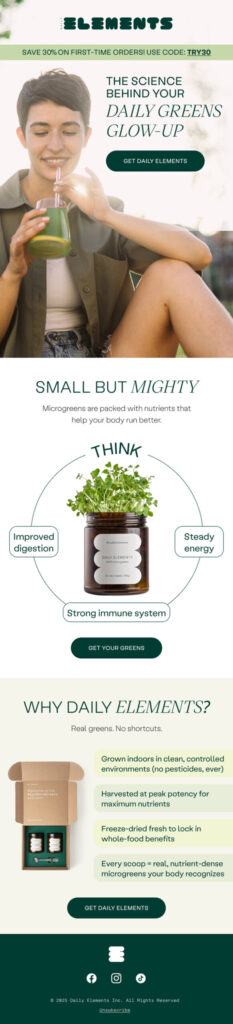
2. Campaign Strategy Designed for Education and Brand Differentiation
Rather than rely on weekly offers or endless promos, we created a campaign calendar built on:
- Seasonal health concerns (gut health, immunity, fatigue)
- Wellness education and transparency
- Subscriber-first messaging and exclusive moments
- Offers with purpose — not just discounts for revenue spikes
This helped Daily Elements cut through the noise and reinforce their value prop without racing to the bottom. And it allowed campaigns to play a deeper role in the customer journey — not just as revenue spikes, but as value reinforcement.

3. Launching Direct Mail as a Net-New Lifecycle Channel
[Insert layering approach visual]
Once the digital lifecycle was optimized, we added direct mail to expand reach and unlock revenue from customers no longer reachable by email or SMS.
This included:
- Lapsed buyers, 45–90 days since last purchase
- Unsubscribed contacts with previous intent
- One-time purchasers who hadn’t responded to flows
Direct mail was positioned not as a branding tool, but a performance layer — retargeting customers with personalized, benefit-forward messaging.
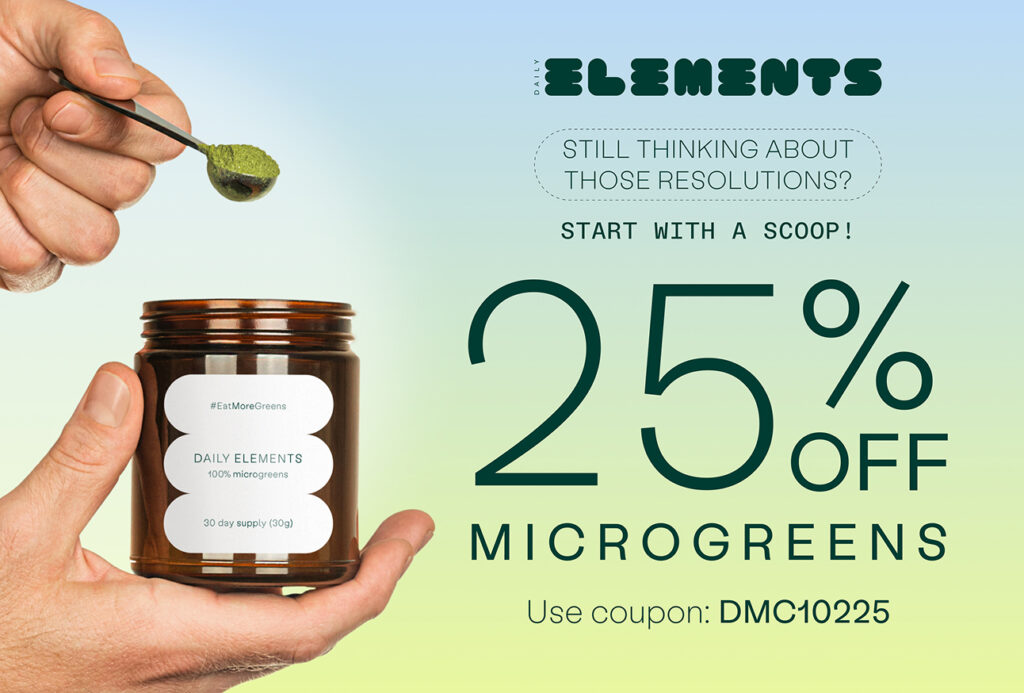
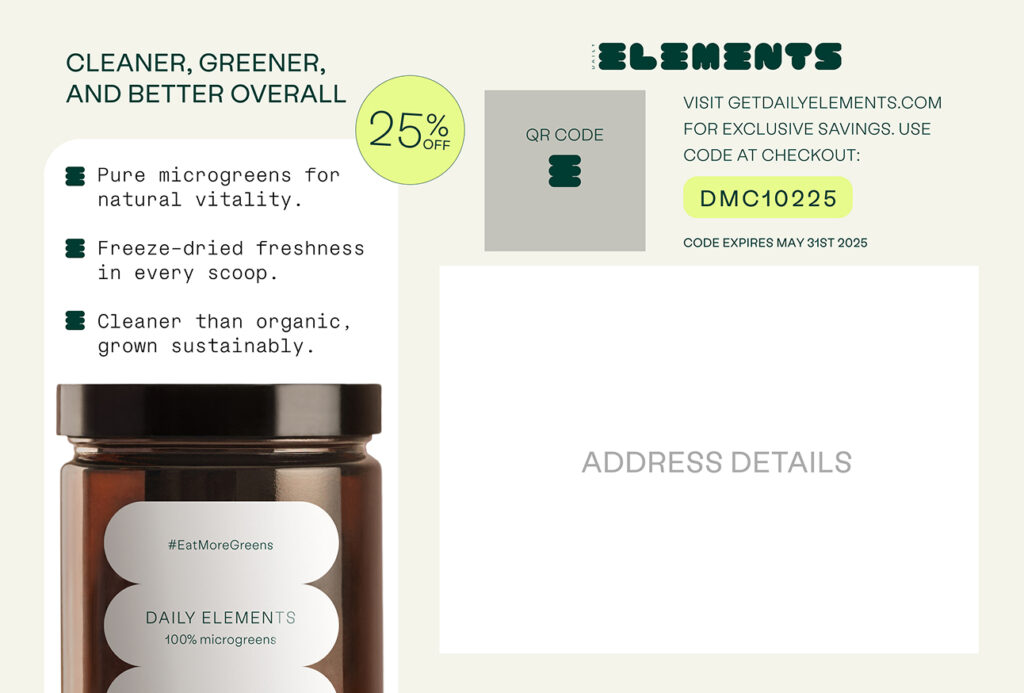
Impact:
- ROAS exceeded 6.5x
- 4x higher conversion rates from disengaged audiences
- Net-new revenue from lifecycle moments that digital couldn’t recover
4. A High-Performance Q4, Enabled by Lifecycle Infrastructure
Heading into Q4, the challenge wasn’t just to drive short-term sales — it was to acquire new customers who would remain profitable and high-LTV into 2025, rather than attracting discount-driven, high-churn buyers.
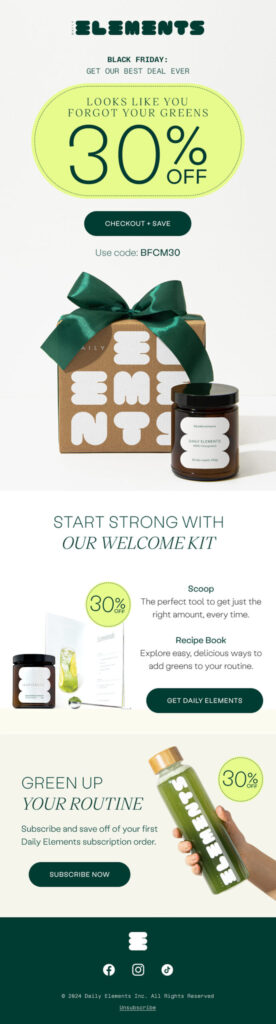
We supported Daily Elements through a complete Black Friday/Cyber Monday plan, including:
- A rebuilt BFCM flow sequence for pre-sale, live sale, and post-sale nurturing
- SMS and email coordination for high urgency and timing control
- Cart and browse flows adjusted for tighter re-engagement windows
- Flexible campaign strategy that adapted in real time once early results exceeded expectations
When the team saw record-breaking sales during Black Friday, we extended the offer into December — retooling content and cadence in real time to maintain momentum without burning out the list.
Outcome:
- 80%+ Increase in Email/SMS Subscriber-to-Purchase Conversion Rate: Indicates that a much larger percentage of new subscribers were converted into first-time customers during Q4 compared to the previous period.
- 60%+ Increase in Website Pop-Up Opt-In Rate: Suggests significantly more new leads were added to the funnel during Q4, fueling top-of-funnel growth.
- Post-Q4 30-Day LTV: Increased by over 25% YoY, meaning new customers acquired in Q4 were not only purchasing — they were retaining value and returning post-sale.
- Post- Q4 Repeat Purchase Rate: Improved by over 20% YoY, indicating Q4 cohorts didn’t churn after the sale but instead re-engaged via flows and campaign nurture.
Results Overview
(June 2024 – June 2025 vs. prior period)
- New subscriber conversion rate ↑ 80%+
- Repeat purchase rate ↑ 20%+
- 30-day LTV ↑ 25%+
- Website pop-up opt-in rate ↑ 60%+
- Flow-attributed revenue ↑ 115%
- Campaign revenue ↑ 90%+
- Direct mail: ROAS 6.5x+, with 4x conversion over typical digital recovery flows
Key Takeaway
In a saturated category where discounting is the default and churn is expensive, Daily Elements needed a different path forward.
Lifecycle marketing became that path — not as a set of tactics, but as a strategic foundation for profitable, scalable growth.
It helped them:
- Convert more leads without eroding brand value
- Retain and educate first-time buyers through structured flows
- Reduce reliance on promotions
- Expand beyond digital with physical reactivation (direct mail)
- And ultimately, build a brand experience that could stand out — not just survive
A white-glove service built for success.
We've planned every part of your client experience so you know you're in good hands.
Related Posts

Chapter 1: E-Commerce Email Marketing Basics
What is ecommerce email marketing? Ecommerce email marketing is the method of sending emails to generate sales, keep email subscribers engaged, and build customer loyalty for your ecommerce business. Email marketing is one of the most critical tools for your ecommerce store because it is an "owned" marketing channel. In other words, your business owns the audience (your email list) and controls the content. Unlike paid marketing channels (ie. Facebook, TikTok, Google) and earned marketing channels (ie. press coverage), email marketing gives you full control over your content, direct access to your audience and you don't have to pay to reach them. This makes email marketing a powerful marketing strategy to nurture, convert, and retain customers by building long-term relationships. Why is email marketing important to grow your ecommerce store? It has one of the highest return on investment (ROI): on average, e-commerce businesses earn $40 for every $1 spent on their email marketing and email marketing generates 20-30% of their business revenue. This makes email marketing one of the most effective channels to generate revenue & convert customers. Here are some of the ways email marketing can generate sales for your ecommerce store: 1. Promoting new products and promotions Announce new product launches...
How To Use Klaviyo Like A Pro – 2024 Complete Guide
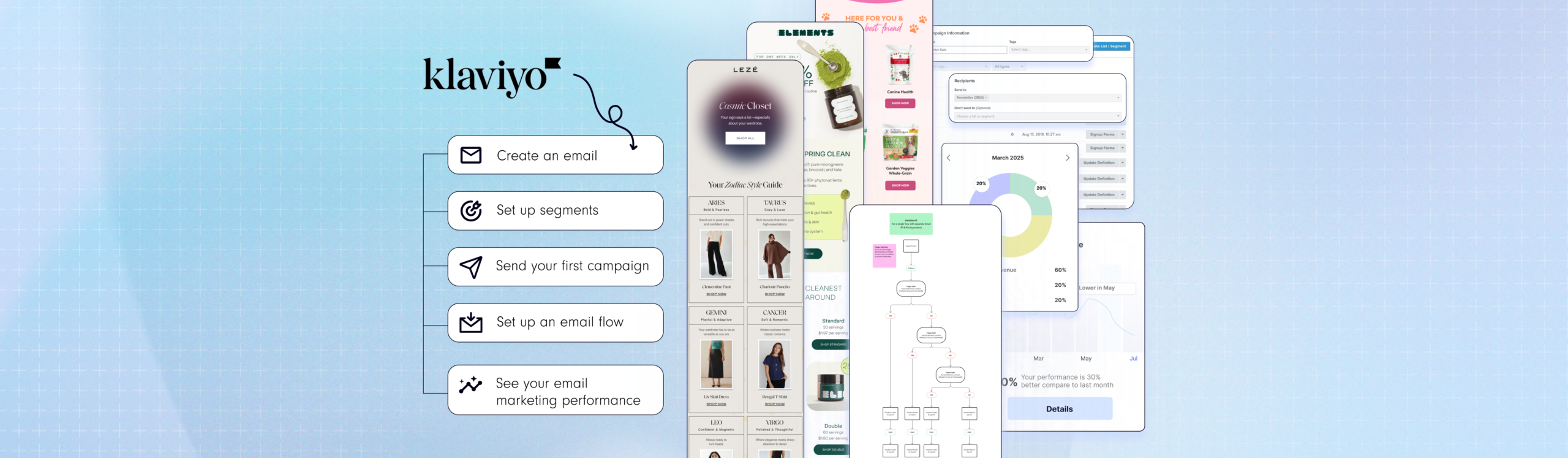
1. Create an emailBuilding an email in Klaviyo is extremely simple with their drag and drop builder. You can also follow the same steps below to create an email for a flow since their email builder is the same for both types of emails.To get started with creating an email in Klaviyo, click on "Email Templates" then click "Create Template". This will bring you to their email builder. This is a good way to get familiar with building an email in Klaviyo before learning to set up flows and send campaigns.Here are the key elements to create emails that engages subscribers and converts customers:Subject Line: The subject line is the main text an email subscriber sees in their inbox before they open the email. You want your subject lines to generate curiosity & interest for the reader to read the email.Preview Text: The preview text is the additional information after the subject line that gives the reader more context on what the email is about within their inbox.Navigation Bar: The navigation bar is typically in every email and directs the reader to key pages on your website.Banner: A banner in an email is typically a short section above the header of the email to...

21 Email Marketing Examples to Inspire Your Next Campaign
In the competitive world of DTC e-commerce, a crucial element of customer retention is keeping customers engaged with your brand. Email marketing campaigns are a great way to stay top of mind and relevant to your customers. It's not enough just to send email marketing campaigns about your product. To drive engagement, loyalty, and sales, you need impactful, unique & relevant email campaign topics. That's where an effective email marketing campaign strategy starts.We've put together 21 email marketing examples that are more than just creative inspirations—they're powerful strategies that have driven results for DTC brands. Use these email marketing examples to inspire your next campaign.Use these email campaign examples to generate 3 new campaign ideas to test in the next 60 days!Effective Email Marketing Examples1. Save The Date EmailsSave The Date emails are perfect for creating anticipation for an upcoming promotion or new product launch. The suspense & advanced notice generates more interest, engagement & revenue on launch day. Add in a calendar invite or link to a Facebook event to easily remind interested customers on the day of launch.We tend to see Save The Date emails consistently work for most e-commerce brands, but are particularly explosive for limited edition...
Email Marketing Metrics: Unlocking the Power of Data to Drive Your Campaigns
Whether you're struggling with the intricacies of Klaviyo's built-in reporting, drowning in an ocean of dashboards, or simply seeking ways to turn your data into actionable strategies, you're in the right place. We're here to help you navigate the complexities of email marketing metrics and tap into the wealth of insights they offer.This blog post is for you if:1. You're still using Klaviyo's built-in reporting & don't know how to interpret the data.2. You have a myriad of dashboards filled with email data, but you're not sure what needs your attention.3. You're feeling overwhelmed with your email marketing data and want to focus on what's important.4. You want to turn your data into actionable strategies to enhance performance.Many DTC ecommerce brands, perhaps even yours, fall into the trap of over-investing in data accumulation and under-investing in actioning on it. This blog post is designed to help you break free from this pattern.What you'll learn in this blog post:1. The key email marketing metrics you should be measuring.2. What your email marketing metrics are telling you about your customers & the effectiveness of your strategy.3. How to interpret your email marketing data through benchmarking red/green/yellow.4. How to devise a plan of...

Email Marketing Analytics and Benchmarking: The Key to Unlocking Your Campaign’s Potential
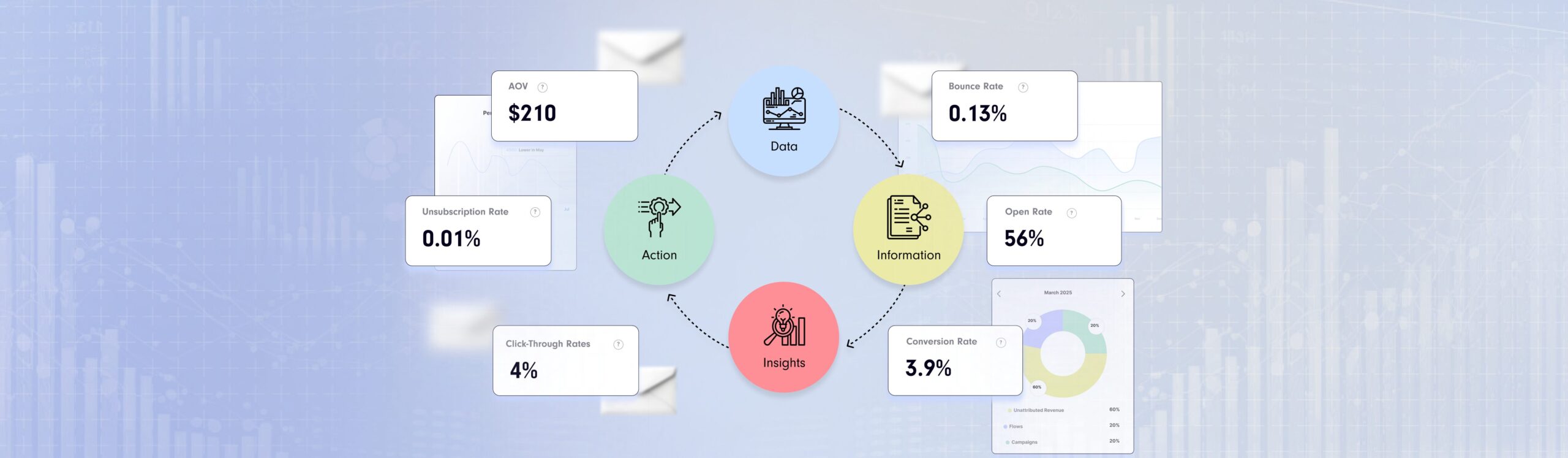
So you've started running email marketing campaigns, but now what? Most DTC brands just collect the data & measure the performance of their email campaigns. But that's not enough.Which email marketing metrics should you look at? How do you analyze your email metrics? What do you do with that data? And how will you actually adjust your strategy to consistently improve your performance over time?It's not what data you have, but how you use the data that will scale your email marketing performance.Meet the principle of Actionable Reporting.Actionable reporting is all about transforming raw data on your email metrics into meaningful, easy-to-understand insights and applying them to actionable next steps in improving your email marketing performance. It's about identifying trends, finding patterns, and flagging opportunities to not only understand what's working but also uncover areas that need improvement.Mastering the art of Actionable Reporting is learning how to turn data into information, information into insights, and insights into strategy.Data --> Information --> Insights --> StrategyThere are 3 key elements to effective Actionable Reporting:Email Marketing Metrics: Collecting the right data is crucial to the start of this process. Email marketing analytics allows you to dive deep into the performance metrics of your campaigns, identifying what works and what...
The 1-2 Punch: How to Combine Direct Mail & Email Marketing to Nurture, Convert & Retain Customers
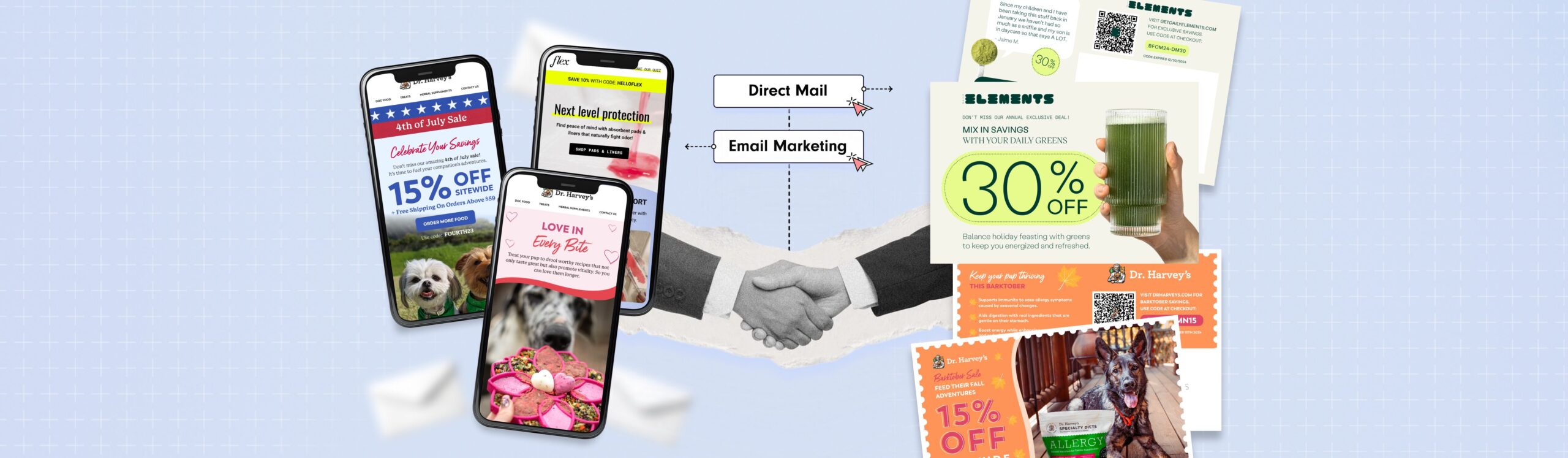
Instagram and avocado toast. Mario and Luigi. Email and direct mail. Think one of these pairs doesn’t belong? Wrong. They’re all things that work beautifully together. Email and direct mail aren’t competitors; they’re complimentary channels in a smart ecommerce marketing portfolio. Together they can help nurture leads, convert customers and increase customer lifetime value. How Direct Mail and Email Marketing Stack UpBefore you start layering direct mail and email marketing together, it’s important to understand the strengths of each channel. Email and direct mail have some significant similarities. Both are trackable and can be automated. Both enable one-to-one personalization—you can customize everything from greetings to visuals to discount codes. The big differences between email and direct mail are in reach, response, speed and cost. One isn’t better than the other—they have advantages that complement one another, which it’s why it’s smart to use them in concert. Reach: Email is easy to send and has a broad reach. Open rates generally max out around 30%. Direct mail has an estimated 90% open rate, because there’s less competition in physical mailboxes. Response: According to Campaign Monitor, the average email click-through rate is 2.3%, which means volume is important. The Data & Marketing Association shows an average 9% response rate for direct mail campaigns,...

The Guide to Email Marketing KPIs: How to Measure and Optimize Your Email Campaigns
Like most marketing channels, growing your email revenue is a process of continual growth and optimization. Once you're regularly sending out email campaigns, your email marketing KPIs will tell you where there is room to optimize, try new campaign ideas, and run A/B tests. E-commerce brands often leave thousands of dollars of revenue on the table because they don't regularly review their performance & optimize their email marketing strategy based on their insights. Sometimes, something as simple as a different send time or a change in the email layout can create 15-20% more lift in revenue. Sometimes, your email marketing KPIs will help you identify new types of email marketing campaigns that your subscribers engage with more.Another common mistake e-commerce brands make is sending out the same few email marketing campaigns each month, which eventually end up feeling repetitive to subscribers. Regularly measuring & optimizing your campaigns includes coming up with new ideas to test.To make the most out of your email marketing efforts, every e-commerce brand should follow this process:Send Email CampaignsUpdate A Weekly Reporting DashboardAnalyze the data at least once a month (ideally weekly!)Identify opportunities for A/B tests, segmentation, and other campaign ideasDeploy new tests & ideas on...
The Ultimate Guide to Different Types of Email Marketing Campaigns
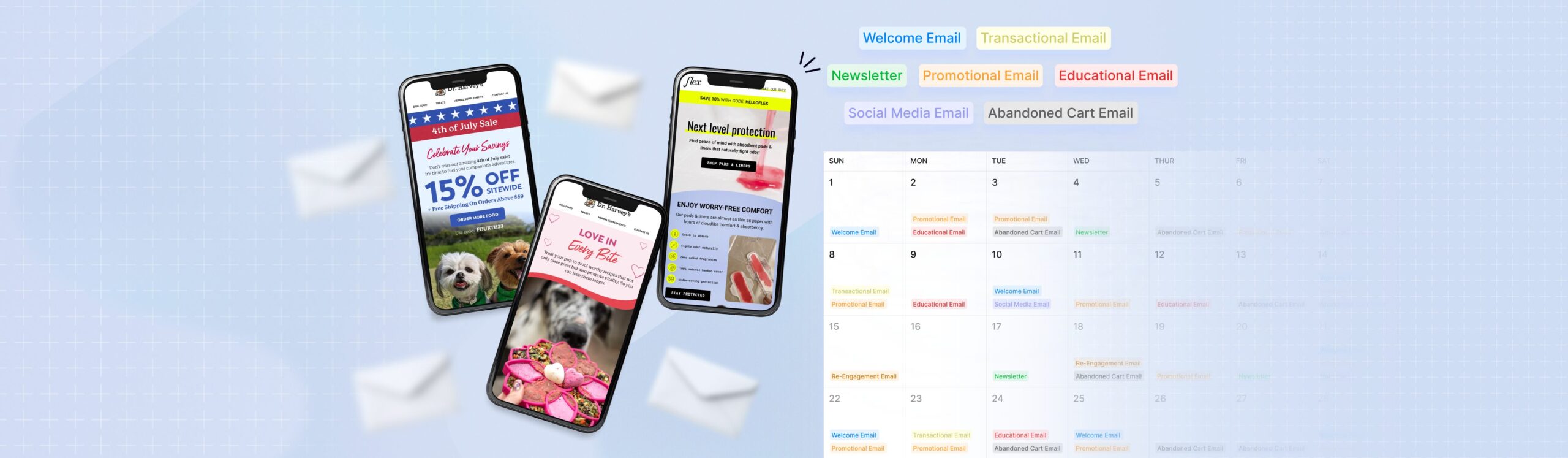
Email marketing is an incredibly important channel to master for any DTC e-commerce business. In fact, with the right approach, email marketing can contribute to a whopping 20-30% of your revenue. It's a great way to retain customers, drive conversions, increase repeat purchase rates, elevate customer lifetime value (LTV), get more customers hooked on subscription products and encourage them to splurge on higher average order values (AOV). But it can feel overwhelming with all of the different types of emails, from email campaigns to automated email flows, that you should have.=If you're new to email marketing —we've got your back with this ultimate guide to the different types of emails. By the end of this post, you'll be ready to create a solid email marketing strategy to get your e-commerce store generating $5M, $10M and even $20M+ in revenue.Get a custom-built email marketing strategy with a 14-day free trial of Backbone.Use Backbone to plan out your email marketing calendar with different types of campaigns, flows, promotions & product launches. With over 5000+ unique campaign ideas & 250+ unique flows, everything is customized for your business!Book Your DemoTypes of EmailsNow, let's dive into the most different types of emails that every...
Mastering the Art of Email Marketing: Best Practices for Success
Email marketing is one of the essential marketing channels that every direct-to-consumer (DTC) e-commerce brands needs to master to grow their revenue, drive conversions, retain customers & build a sustainable, scalable business. With this guide, you'll be able to get from zero to launched & start driving revenue from email marketing. We'll break down the email marketing best practices, from planning your campaigns to analyzing the results.Don't have time to master email marketing yourself?Get started with Backbone to get a custom-built email marketing strategy & email layouts for your business, all based on email marketing best practices.Book Your DemoPlanning Your Email CampaignDefining Your ObjectivesRevenue is always the end goal for any DTC e-commerce brand, but how will this email campaign drive revenue? Before launching your email marketing campaigns, start by defining the objective of the campaign.Here are a few different ways that email campaigns drive revenue:By announcing something new & exciting (such as a promotion, product launch or collaboration)By creating urgency (such as a limited edition product selling out or a promotion ending)By educating customers (such as content emails & seasonal tips)By showing how your product can solve a customer's problems (such as showing how your product works)By showing the benefits of your product...

From Idea To Launch: How To Create A Successful Email Marketing Campaign – 2024 Guide
Email marketing is a powerful tool that can help ecommerce stores nurture, convert & convert potential customers. In fact, email marketing should be generating 20-30% of the total revenue for your ecommerce store.However, creating an effective campaign that converts customers & generates revenue requires more than just adding images & copy to an email template.In this guide, we will walk you through the step-by-step process of building & launching an email marketing campaign from idea to launch. This email workflow will help you build an email marketing strategy for your campaign, write engaging copy, design an email that converts, and send it to the right audience.You'll also learn actionable tips to help you create campaigns that drive engagement and revenue for your business. Whether you're new to email marketing or a seasoned pro, this guide will give you the tools and knowledge you need to create successful campaigns that drive results.Step 1 // Email Brief: Building Your StrategyThe first step in creating a successful email marketing campaign is to develop an email brief. This is typically done by the Email Marketing Manager or the Head of Marketing. An email brief is a document that outlines the key information for your...

Building An Email Marketing Team: The 6 Roles Of A Dream Team
Often ecommerce stores grow from 6-figure to 7-figure & 8-figure companies before they wish they had invested more into email earlier on. Often this means ecommerce stores are easily leaving hundreds of thousands of dollars on the table.Email marketing is a powerful tool for any business, and it's essential to have the right team in place to maximize its potential.But what does an effective email marketing team look like?From the strategic planner to the creative designer, each role plays a vital part in building a team that can strategize, create and execute effective email campaigns that drive engagement and revenue.By understanding these roles and how they work together, you'll be able to build a team that can take your email marketing efforts to the next level.Here we'll explore the 6 key roles that make up a dream email marketing team, and how each role contributes to the success of your email marketing efforts:1. The Email Marketing ManagerA successful Email Marketing Manager also known as an Email Strategist, is able to develop and implement a comprehensive email marketing strategy that aligns with the overall business goals, and consistently delivers results in terms of email engagement, conversions and revenue.They lead and manage...